Experiential Public Work and the Need to Reconnect Cities
Something is shifting in public art. Not away from cities—but deeper into them. Across contemporary practice, artists are moving away from the idea of the artwork as object and towards something more unstable: experience, encounter, and public & mental interruption.
Molly Gochman’s work sits inside this shift. Moving between sculpture, land-based installation, and distributed interventions across urban space, her practice resists the idea of a single fixed monument.
In works such as ‘Monuments to Motherhood,’ bronze forms reframe the language of public sculpture by centering care and domestic labour rather than authority or power. Elsewhere, in projects like Dispersed Geographies, meaning is broken across multiple points in a city—encountered only through movement, repetition, and recognition over time.
The work does not declare itself. It accumulates. And that feels increasingly characteristic of where public art is heading: less spectacle, more sustained attention. Less object, more encounter.
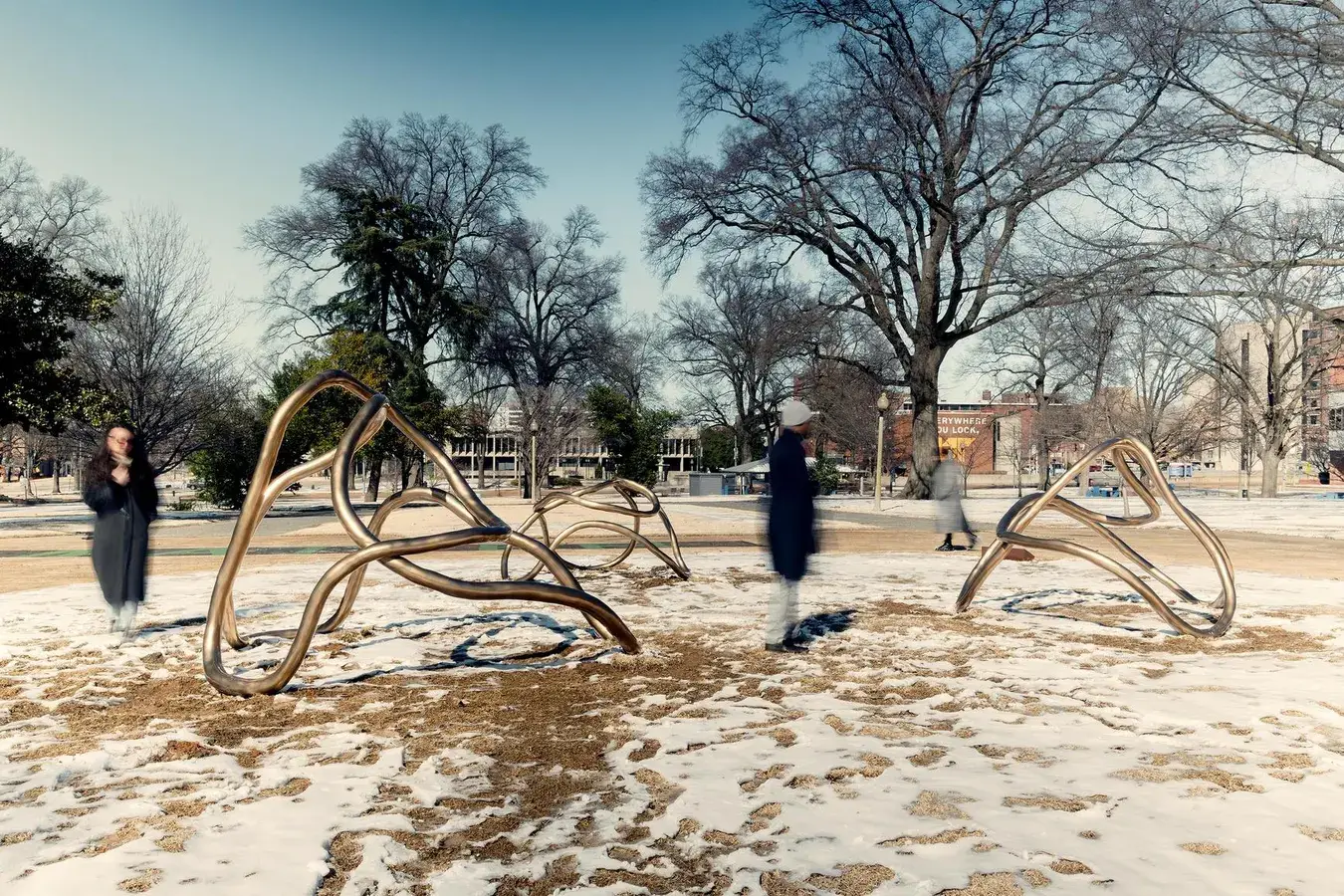
• 'Monuments to Motherhood,' 2025, by Molly Gochman - Unveiled on Contested Ground in Memphis.
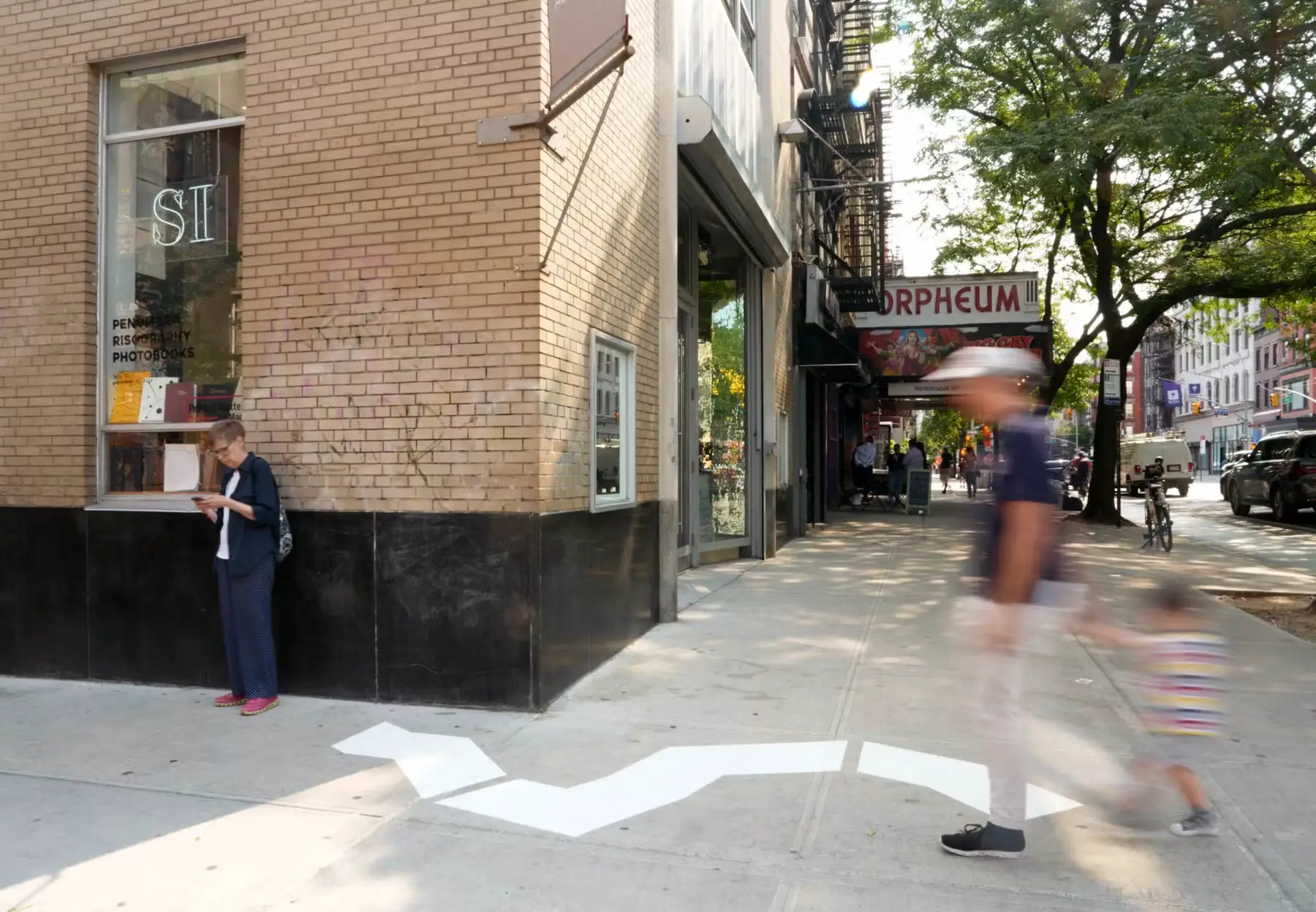
• 'Dispersed Geographies,' 2025, by Molly Gochman.
Walk down Charlton Street in Somers Town after dark and this shift becomes visible in a different register. The pavement begins to glow. Words appear on walls—not graffiti, not advertising—but poetry suspended in light.
This is Poetry in Lights, a collaboration between Robert Montgomery, A Space for Us People’s Museum, Euston Town BID and MTArt Agency. Five projected poems, created through workshops with local residents, now illuminate one of London’s most historically charged neighbourhoods. It feels simple. It isn’t.
Somers Town sits between Euston and King’s Cross—two of London’s most aggressively transformed districts. A place shaped by early social housing, literary history, and working-class continuity, now under pressure from redevelopment and rising property values.
The question is no longer abstract: what happens to a place when the people who built it can no longer afford to stay?
Poetry in Lights answers without slogans. Instead, it returns language to the walls of the neighbourhood itself—breaking the endless onslaught of advertising that Marine Tanguy says is plaguing us day in and day out. In her book The Visual Detox she writes "You consume 10,000 visuals daily. Let's change it." Her agency, MTArt Agency, pushes for artists and public art projects everywhere, interrupting the constant cycle of advertising—One wall at a time.

• Marine Tanguy's book, The Visual Detox. Questioning consumption frameworks.
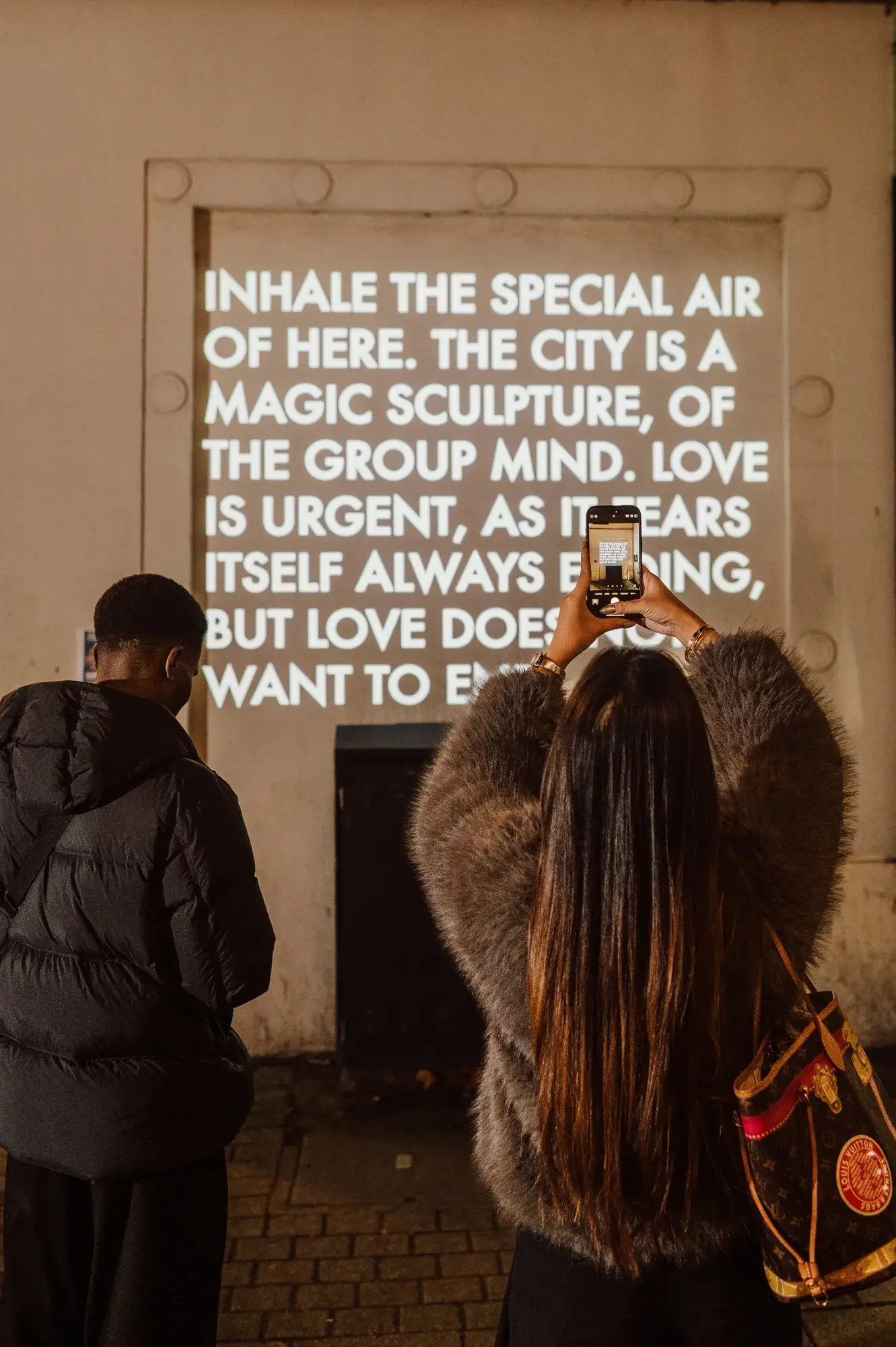
• From Montgomery’s Poetry in Lights, for Somerstown. Featured by Halcyon Gallery.
Robert Montgomery has spent over two decades working with language in public space—interrupting advertising systems, projecting text into cities, and turning poetry into physical presence. But here, the work shifts scale. It becomes collective rather than authored.
The most powerful thing it does is not aesthetic—it’s relational. It asks who a city belongs to, and who gets to speak inside it.
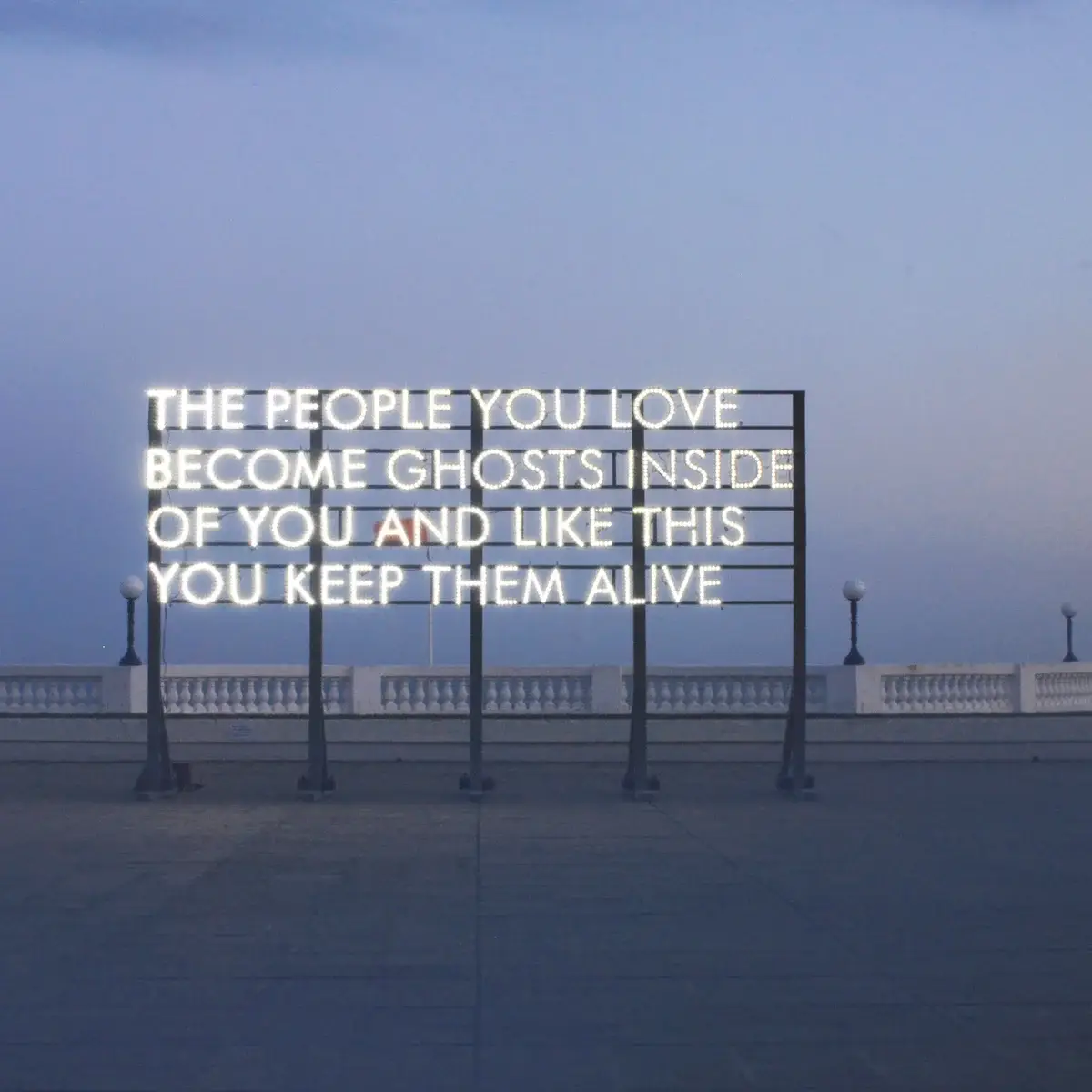
• One of the most famous Light Poems by Robert Montgomery. Shared millions of times over across global networks.
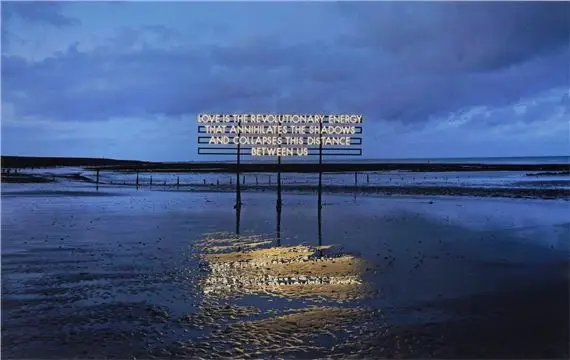
• "Love is the revolutionary energy..." statement landscape canvas by Robert Montgomery.
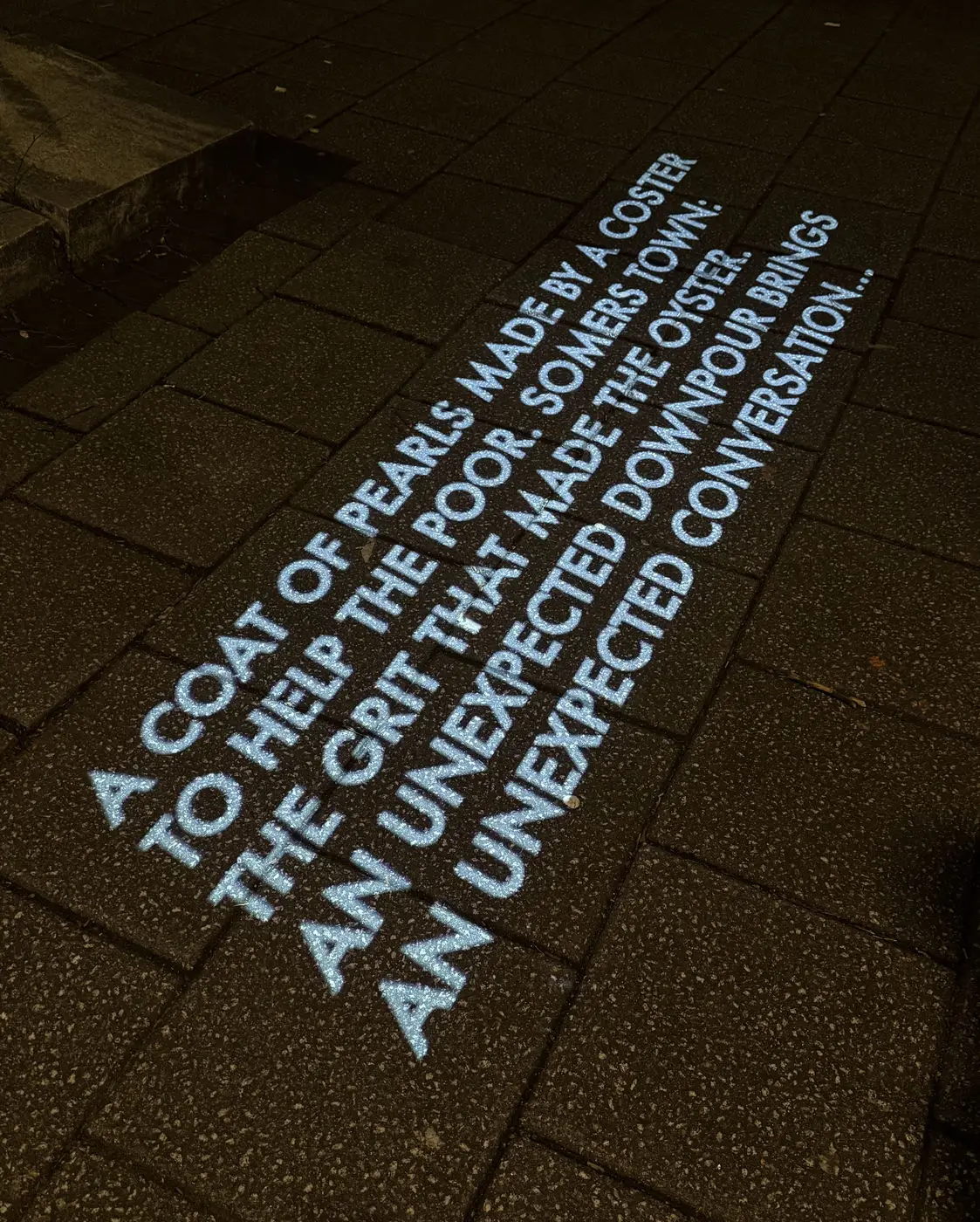
• Another from Montgomery’s Poetry in Lights, for Somers Town. Opening marked by community drums, dancing and mulled wine.
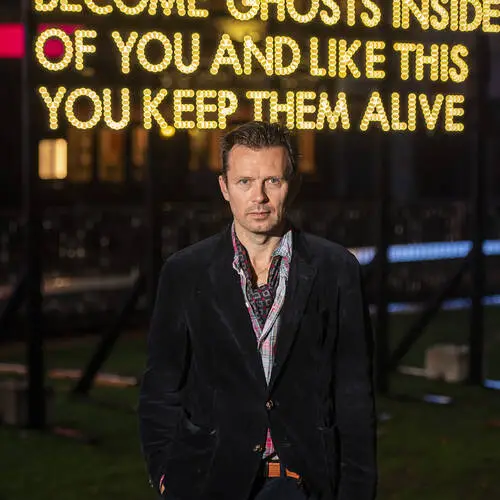
• Robert Montgomery - Light After Dark. Featured by Art of London.
Elsewhere, similar instincts appear in large-scale temporary works.
In Venice, Lorenzo Quinn’s Support placed monumental hands in the Grand Canal, briefly holding up a historic façade in a gesture about fragility and collective responsibility. Saype’s vast biodegradable paintings - interlocking human chains spread across grass landscapes from the Eiffel Tower to the United Nations - exist only for a moment before disappearing entirely.
Their temporary nature is not a limitation. That is the point.
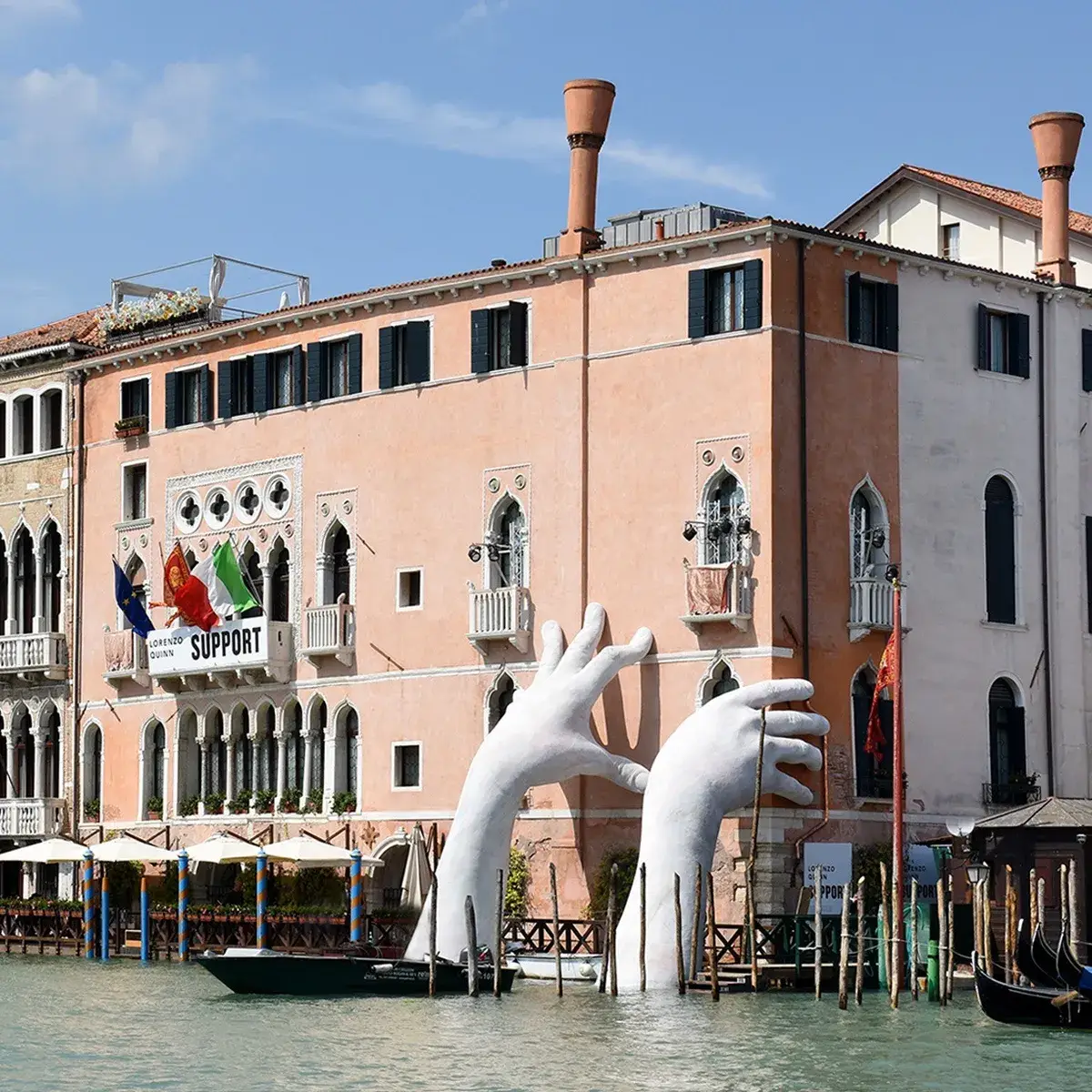
• The famous Hands sculpture by Lorenzo Quinn, highlighting the impact of climate change on historic architecture in Venice.
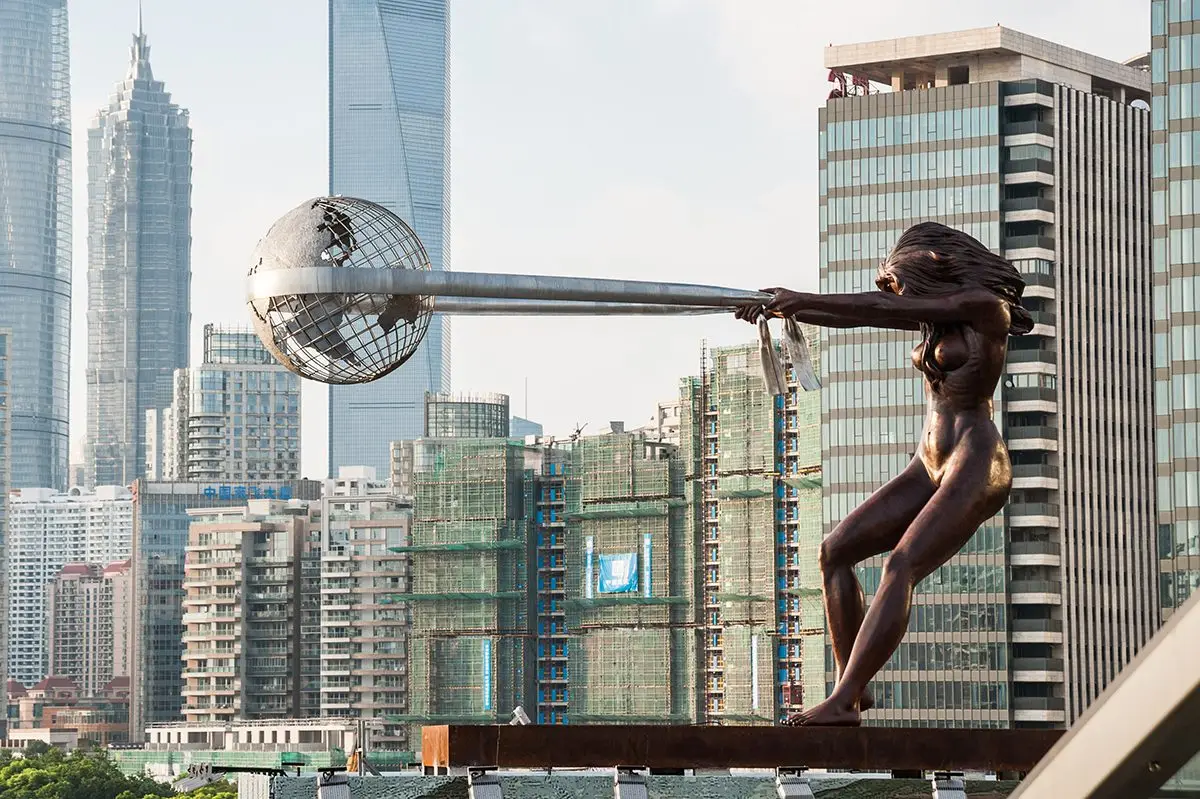
• 'The Force of Nature I' sculpture configuration by Lorenzo Quinn.
Even in New York, public art has shifted into this register. The city’s Department of Transportation has commissioned hundreds of temporary works across its boroughs, murals, ground paintings, and street interventions that treat everyday infrastructure as exhibition space. A 160-foot walking path in Times Square by Shantell Martin becomes a moving drawing. A mural in Harlem by Fitgi Saint-Louis honours the women holding communities together.
These are not secondary encounters with art. For many people, they are the first.
What connects these practices is not medium, but intent.
They are not trying to outlast the city.
They are trying to enter it.
And in a moment of accelerating displacement - where neighbourhoods are continually redesigned, optimised, and priced upwards - this shift feels significant.
Public art is no longer only about what is installed in a place. It is about what is felt inside it.
Memory rather than monument.
When you are in cities today… Look up from your phone. Take that breath. Let it register. The work may be gone tomorrow. But the experience will not be.
artwork credits:
Molly Gochman : Robert Montgomery : Lorenzo Quinn : MTArt Agency